| Nume | Prenume | Rol | Instituție |
|---|---|---|---|
| Cârciumaru | Marin | Complexul Naţional Muzeal "Curtea Domnească", Târgovişte | |
| Dincă | Remus Constantin | Universitatea de Vest, Timişoara | |
| Micle | Dorel | responsabil | Universitatea de Vest, Timişoara |
| Niţu | Elena Cristina | responsabil sector | Complexul Naţional Muzeal "Curtea Domnească", Târgovişte |
| Stavilă | Andrei | Universitatea de Vest, Timişoara |
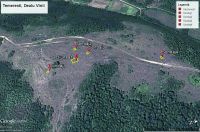
Obiectivul arheologic a fost descoperit în urma cercetărilor sistematice de teren efectuate în ianuarie 2015. Având în vedere că singurele materiale arheologice descoperite în primele investigaţii erau doar piese litice, precum şi amplasarea destul de aproape a punctului de la Temereşti de alte două aşezări paleolitice - Coşava şi Româneşti, s-a impus necesitatea delimitării cu certitudine a arealului staţiunii... şi o datare cât mai precisă a acesteia. Existenţa unei exploatări de nisipuri, pe platoul învecinat punctului în care s-a făcut săpătura, a permis observarea stratigrafiei generale a zonei. Astfel, încă de la începutul cercetării, s-a putut observa că, în funcţie de localizare, nivelurile cuaternare, situate deasupra unor depozite terţiare, nu sunt foarte groase. De asemenea, pe platoul unde au fost identificate materialele arheologice, au fost făcute mai multe secţiuni geologice, unde s-a putut analiza, înaintea începerii săpăturilor arheologice, grosimea depozitului în care au fost descoperite artefactele (adâncimi de maxim 1 m de la suprafaţa solului). Având în vedere că platoul Dealul Vinii este înconjurat de alunecări de teren, după analiza situaţiei geomorfologice, s-a ajuns la concluzia că doar partea centrală a platoului mai poate fi exploatată din punct de vedere arheologic. Din aceste considerente, s-a hotărât săparea unei secţiuni mai ample pentru identificarea unor eventuale niveluri arheologice, precum şi efectuarea unor sondaje pentru delimitarea arealului aşezării. Pentru verificarea existenţei unei aşezări arheologice, au fost efectuate trei sondaje în puncte diferite ale platoului, precum şi o secţiune de 15 mp (5 x 3m). Secţiunea a fost amplasată pe partea cea mai dreaptă a terenului, pentru a evita eventualele deranjamente, fiind împărţită în carouri de 1 mp fiecare. Consistenţa dură a sedimentului, precum şi prezenţa a numeroşi galeţi de diferite dimensiuni pe întreaga coloană stratigrafică, a impus săparea planimetrică a secţiunii, prin raderi succesive. Succesiunea depunerilor geologice în SI este următoarea (culorile sunt date după Munsell Soil Color): 1. sediment lutos, foarte slab nisipos, pulverulent, gălbui deschis-maroniu (HUE 10 YR 6/4 light-yellowish brown); 2. lutos nisipos, slab pulverulent, gălbui-maroniu (HUE 10 YR 5/6 yellow-brown); 3. lutos nisipos cu desprinderi prismatice, având în componenţă mulţi galeţi de diferite dimensiuni; culoare gălbuie (HUE 10 YR 7/8 yellow); 4. nisipos slab lutos, cu foarte mulţi galeţi în componenţă, roşcat-gălbui (HUE 7,5 YR 6/6 redish-yellow). Singurele categorii de materiale arheologice descoperite sunt reprezentate prin piese litice. Nu a fost descoperit niciun fragment faunistic şi nicio structură de combustie, prin urmare, structurile evidente lipsesc. De altfel, acest lucru este caracteristic pentru toate siturilor paleolitice aurignaciene din Banat, Tincova, Coşava, Româneşti. Chiar dacă densitatea materialelor arheologice pe fiecare carou nu a fost prea mare, săpătura s-a realizat cu toată rigurozitatea, cu decapări cuprinse între 2 şi 5 cm grosime. Întreg sedimentul a fost tamisat, astfel fiind eliminate pierderile inerente unei săpături, îndeosebi piesele de mici dimensiuni (lamele, micro-aşchii, spărturi etc.). În primele trei depuneri au fost descoperite materiale arheologice, prin urmare adâncimea maximă a descoperirilor este de aproximativ 80 cm. De altfel, aceeaşi situaţie a fost remarcată şi în celelalte situri paleolitice din zonă, adâncimi mai mari fiind surprinse doar acolo unde secţiunile au fost amplasate greşit pe panta platourilor, ceea ce a implicat deranjamente multiple din cauza valurilor de alunecare (spre exemplu la Coşava). Prezenţa unor nuclee groase, carenate, adeseori trecute în categoria gratoarelor, a unor lamele fin retuşate (încadrate ca lamele Dufour), precum şi a cioplirii majoritar unipolare convergente a nucleelor, au fost elementele definitorii, încă de la începutul cercetărilor, pentru plasarea materialelor din Banat în diverse faze ale Aurignacianului. Desigur, pentru respectarea schemei clasice, primul nivel era definit mereu ca fiind Gravetian sau Epigravetian. Pentru săpătura efectuată la Temereşti, dacă am căuta o apropiere tipologică cu uneltele clasice din vestul Europei, evident că ar exista destule indicii pentru includerea materialelor, cel puţin în parte, în Aurignacianul din Banat. Însă caracterul eterogen al ansamblului nu ne permite acest lucru, chiar dacă este destul de similar cu celelalte aşezări. De altfel, considerăm că încadrările făcute doar pe baze tipologice nu sunt relevante, de aceea cercetările trebuie continuate în această zonă. În acest moment, cel mai probabil, materialele aparţin unui paleolitic superior întârziat (cel puţin pentru piesele găsite în stratele I şi II), existând posibilitatea apartenenţei unei culturi mai vechi a paleoliticului superior pentru materialele din stratul III.
The archaeological site was discovered following systematic land research carried out in January 2015. Taking into account that the only archaeological materials discovered during the first investigations were only lithic pieces and that the Temereşti site was located pretty close to other two Palaeolithic sites – Coşava and Româneşti – we had to delimitate with certainty the station area and to date it as accurately as possible.
The existence of a sand mine on the plateau close to the excavation point allowed a general stratigraphic survey of the area. Thus, ever since the beginning of the research, we could notice that, depending on location, Quaternary levels above Tertiary deposits were not very thick. Likewise, on the plateau where we identified archaeological materials, we made several geological sections where we could analyse, before starting digging, the thickness of the deposit where we the artefacts were discovered (depths at maximum 1 m deep in the ground).
Taking into account that the plateau of the Vinii Hill is surrounded by landslides, after the analysis of the geomorphologic situation, we reached the conclusion that only the central part of the plateau can be exploited archaeologically. Therefore, we decided to dig a wider section to identify possible archaeological levels and to establish the limits of the settlement area.
To check the existence of an archaeological settlement, we made three soundings in different points of the plateau and a 15-m2 section (5 x 3 m). The section was set on the straightest side of the land to avoid possible disturbances, which we split into squares of 1 m2 each. The hard consistency of the sediment, as well as the presence of numerous boulders of different sizes along the stratigraphic column asked for planimetric digging of the section through successive shaving.
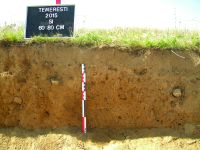
The succession of geological deposits in the SI is as follows (colours are give after Munsell Soil Colour):
5. Clayey sediment, very little sandy, powdery, light yellowish-brown (HUE 10 YR 6/4 light-yellowish brown);
6. Clayey sandy sediment, little powdery, yellow-brown (HUE 10 YR 5/6 yellow-brown);
7. Clayey sandy sediment with prismatic detachments, containing many boulders of different sizes; yellow (HUE 10 YR 7/8 yellow);
8. Sandy little clayey sediment, with very many boulders, reddish-yellow (HUE 7.5 YR 6/6 reddish-yellow).
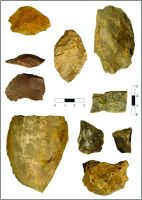
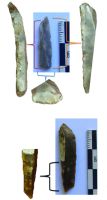
The only categories of archaeological materials discovered were lithic pieces. We found no fauna fragment or combustion structure, hence the lack of obvious structures. This is characteristic of all Aurignacian Palaeolithic sites in Banat, Tincova, Coşava, and Româneşti.
Though the density of archaeological materials in each square was not high, the excavation was made rigorously, with picklings 2-5 cm thick. The entire sediment was sieved to avoid inherent losses when digging, particularly small pieces (blades, microchips, crocks, etc.).
In the first three deposits, we found archaeological materials at a maximum depth of about 80 cm. The same happened in the other Palaeolithic sites in the area; there were deeper diggings where the sections were misplaced on the plateau slope, which involved multiple disturbances because of the landslides (for instance, in Coşava).
The presence of thick, hulled nuclei, often grouped in the grater category, of finely sharpened blades (classified as Dufour blades), as well as of convergent unipolar carving of the nuclei were defining ever since the beginning for the setting of Banat materials in different periods of the Aurignacian. Of course, to observe the classical scheme, the first level was always defined as Gravetian or Epigravetian. For the digging at Temereşti, if we were to look for a typological similarity with western European tools, there would be enough clues to include the materials, at least partially, in the Banat Aurignacian. However, the heterogeneous character of the site does not allow that, though it is quite similar with the other settlements. However, we consider that the classifications made on typological grounds alone are not relevant: this is why research should be continued in the area. Now, the materials belong most probably to a late upper Palaeolithic (at least for the pieces found in the layers I and II), and possibly to an older upper Palaeolithic (for the pieces in the layer III).
Kels et al. 2014: Kels H., Protze J., Sitlivy V., Hilgers A., Zander A., Anghelinu M., Bertrams M., Lehmkuhl F., Genesis of loess-like sediments and soils at the foothills of the Banat Mountains, Romania – Examples from the Paleolithic sites Româneşti and Coşava, Quaternary International, 351, 2014, 1-18.